Focus on Value: How Project Managers Make Better Trade-offs
Most project managers learn trade-offs as a negotiation between scope, time and cost. Pull one lever and the others move. On well-defined work, that model describes most of the decisions a project manager makes, and it has earned its place. Its weakness is where it draws the line. Everything inside the triangle belongs to the project, and everything outside it is treated as somebody else's concern.
The trade-offs that later prove most expensive usually had costs that landed outside that line. They fall on the operations team that inherits the result, or the neighbouring project that lost its best engineer. They fall on the community living beside the site, or on a maintenance budget ten years from now.
Thinking about wider impact means widening the set of consequences you weigh before you choose. It then means judging the options by the value the project exists to create. In practice that comes down to three questions, asked early:
- Who else is affected by this option?
- When will they feel it?
- Who has the authority to accept that cost on the organisation's behalf?
These questions fit inside planning and change conversations you already hold. What changes is how far past the project boundary you look when you answer them.
How a sensible saving becomes a poor trade-off
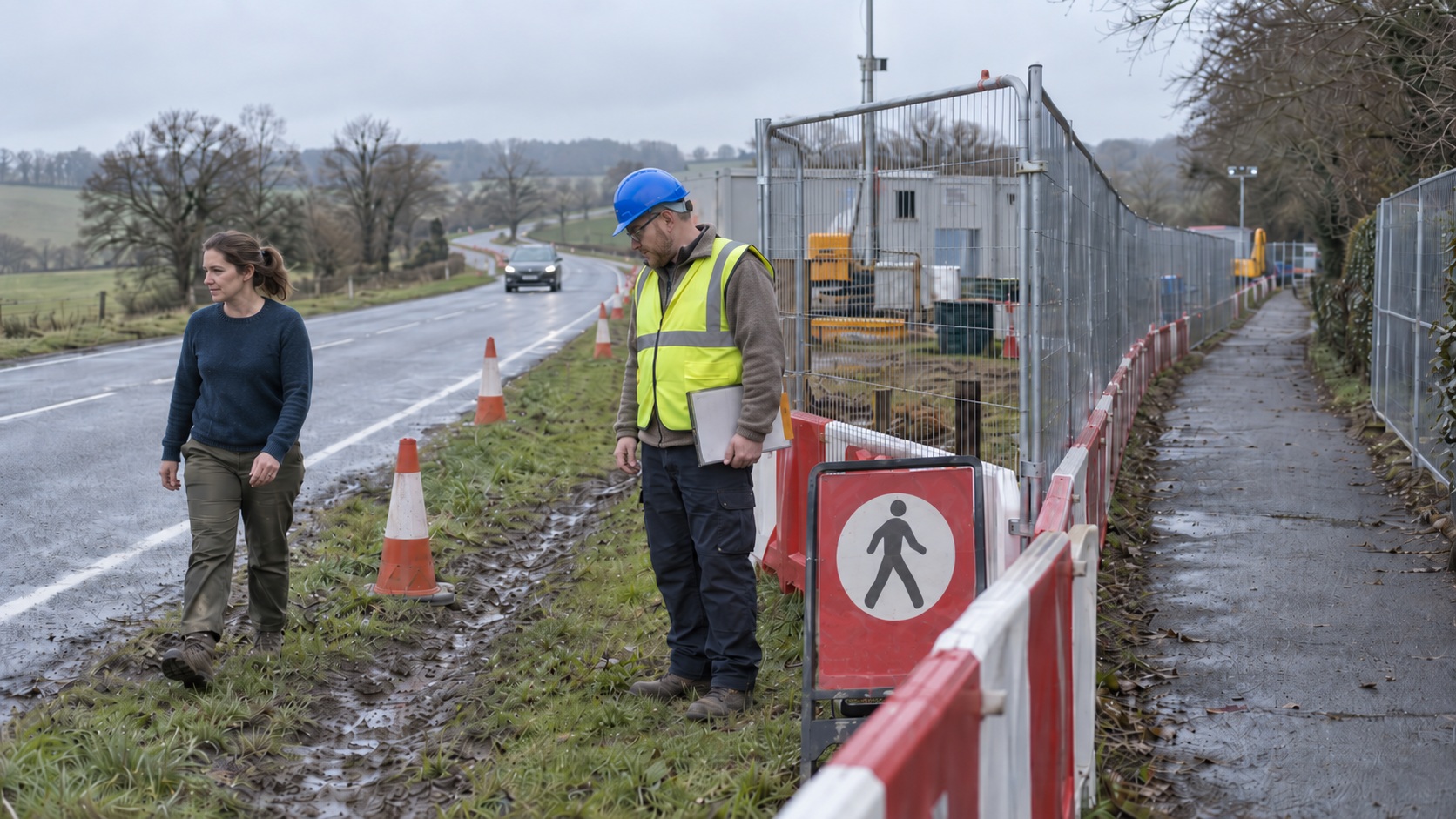
Consider a highway improvement scheme on a rural B-road, sponsored by the local highway authority to make the route safer. Partway through, the contractor proposes a change. Instead of keeping a fenced pedestrian walkway alongside the works, which would have to be moved at each phase, they would close the public footpath for the full duration. The saving is real: eleven days off the programme and a useful reduction in temporary works cost.
The project manager checks the proposal carefully. The closure is permitted under the approved traffic management arrangements. The cost reduction sits comfortably within their delegated authority, and the schedule gain protects a milestone the sponsor cares about. The change is approved.
The closure took eleven days off the programme. Within a fortnight, the people who walked to the village school had worn their own path along the verge, a metre from passing lorries. Complaints reached the parish council and then the local paper. The sponsor spent several weeks handling the reputational fallout. A temporary walkway was eventually installed in a hurry, at a higher cost than the original arrangement, and most of the schedule gain went with it.
Every figure the project manager checked was correct, and within their own frame the decision was reasonable. The failure lay in which consequences were considered at all. The scheme existed to make travel on that road safer. The approved trade-off made the road less safe for one group of its users while the work was under way. Had anyone asked whether the option undermined what the project was for, the answer would have been obvious in under a minute.
Looking past the project boundary
The Standard for Project Management makes this wider view explicit. Section 3.3.1 addresses project impact as part of the principle of adopting a holistic view. It recognises that a project's effects reach beyond its own deliverables and beyond the people formally involved in it. That principle sits alongside the principle of focusing on value, and the two work best together. The holistic view shows you where to look, and the value focus gives you a basis for weighing what you find.
There is no fixed list of places to look, but a few recur often enough to be worth checking by habit.
Operations. This is usually the first place a local saving turns into someone else's cost. A system delivered without adequate training material, or a facility handed over before maintenance access has been properly tested, may look complete on the project's books. The support desk or estates team will then absorb the difference for years.
Other work drawing on the same people and budgets. Moving a specialist onto your critical path may protect your date while quietly putting another project's date at risk. If both projects serve the same portfolio objective, the organisation may have gained nothing.
Communities, suppliers and the physical environment. These sit furthest from the project team's daily attention, which is why they are easy to miss. The footpath closure is one example. Others include a procurement choice that shifts environmental or social cost into the supply chain, or a working pattern that disturbs residents. Sustainability belongs here as a legitimate factor in the trade-off. It does not automatically outrank safety, legal obligations or feasibility.
Time. This is the dimension most often left out. A cheaper design with higher running costs, or a shortcut in software that will need reworking before the next release, moves cost into a period the project will never report on. Whole-life thinking asks the project manager to keep that later period in view while the current choice is still open.
Not every decision needs all of this examined in depth. A proportionate habit is to spend a moment on each area whenever an option changes how, where or when the work is done. Go deeper only where something surfaces. Most options pass quickly. The few that do not are exactly the ones that deserve the extra attention.
Putting the trade-off in front of the right person
Wider impact creates a governance question as well as an analytical one. When the cost of an option falls on another budget, another team or the public, accepting that cost may sit outside the project manager's authority, even when the project's own figures look acceptable. In the highway example, the cost change was within delegated limits. The reputational and safety exposure belonged to the sponsor, and the sponsor never saw it as a choice.
A good trade-off decision therefore makes four things visible:
- what the option gains;
- who bears the cost;
- when that cost arrives;
- whose authority covers accepting it.
This does not mean every impact goes to the steering group. Clear tolerances let the project manager accept minor external effects and record them. Anything beyond those tolerances goes to the person entitled to decide. A short entry in the decision log, recording the rationale and who accepted the consequence, gives the later conversation something factual to stand on.
The mechanics differ by approach, but the judgement does not. On predictive work, wider impact usually enters through change control and through periodic checks that the business case still holds. The discipline lies in making sure the change assessment asks about consequences beyond scope, schedule and cost. On adaptive work, value is reassessed each time the backlog is ordered. Wider impacts such as support load, accessibility or data handling can become backlog items or acceptance criteria. Once they are recorded that way, they are weighed alongside features instead of discovered after release. Hybrid arrangements need both. A delivery team can order its backlog well while the governance layer still commits the organisation to an external cost nobody examined.
Sometimes the value lens points somewhere uncomfortable. If the wider cost of continuing now outweighs what the project will deliver, the honest trade-off may be to reshape or stop the work. Money already spent is not a reason to spend more.
Carrying the habit into exam preparation and live projects
For a PMP® candidate, this topic connects directly to the current exam. The 2026 Examination Content Outline includes a Process task on helping to ensure value-based delivery, which covers examining business value throughout the project. The same outline describes project success in terms broader than schedule, budget and scope, pointing towards stakeholder value and outcomes. The exam assesses this through scenario-based questions, not recall. So the useful preparation habit is to notice when a scenario offers an attractive saving, then ask where its cost goes before judging the options.
For a candidate, the important distinction is between an option that protects the baseline and an option that protects the outcome. Sometimes they coincide, and sometimes they do not. Be wary of shortcuts in the other direction too. "Consult the stakeholders" is not a universal answer, and a value focus still requires a decision within someone's authority.
Being able to name who bears the cost of an attractive option is exactly the judgement practised through scenario work in Omega's PMP® Exam Preparation course. Seeing the pattern across many varied situations makes it easier to spot on a live project.
On real projects, the change is small and practical. Add one line to your options papers and change assessments: who else feels this, and when? Ask it in the room when a saving is proposed, while the option can still be shaped. Revisit it at lessons-learned points, because the external costs a project did not anticipate are among the most useful knowledge it can pass on.
Interested in going further?
Weighing a visible saving against costs that fall on people outside the project is difficult to practise alone, because those costs rarely appear in the project's own reports. Structured PMP preparation gives you repeated, varied scenarios in which to test how widely you look before you choose.
For the principles behind project impact and value, the PMBOK® Guide Eighth Edition, together with The Standard for Project Management, is the reference to read alongside this article.
Ad · Amazon affiliate link.
References
A007: The Standard for Project Management vs the PMBOK Guide
A034: Think in Systems, Not Silos
A065: Choose the Approach Around the Deliverable
A043: When Should a Project Manager Escalate?
A204: How to Think Through an AI or Sustainability PMP Scenario
PMP and PMBOK are registered marks of the Project Management Institute, Inc.