Why UK Construction and Infrastructure Employers Ask for APM PMQ by Name
Scroll through enough construction and infrastructure job specs and a pattern appears that doesn't show up in most other sectors. Employers don't ask for "a recognised project management qualification." They ask for APM PMQ, spelled out, sitting in the essential criteria rather than the desirable list, sometimes with nothing else named alongside it.
That's a strange thing to filter on, on the surface. PRINCE2 is more widely held. PMP carries global recognition. A candidate with fifteen years delivering infrastructure programmes and a PRINCE2 Practitioner certificate can find themselves screened out before a human reads the CV, while someone two years into their career with a PMQ and comparatively little delivery experience clears the same filter without difficulty.
Recruiters get asked about this constantly, and the honest answer most of them give is that it's simply what the client specified. That's true, but it isn't the reason. Somewhere upstream of the job spec, someone decided that PMQ, specifically, is what this role needs, and that decision has a traceable source.
It starts with Grenfell. The Building Safety Act received Royal Assent in April 2022 and came fully into force two years later, in April 2024, following the Independent Review of Building Regulations and Fire Safety that the tragedy prompted. The Act rewrote how buildings are constructed and maintained in England, and it introduced additional duties for Higher Risk Buildings: broadly, anything at least eighteen metres tall or seven storeys, plus care homes and hospitals regardless of height.
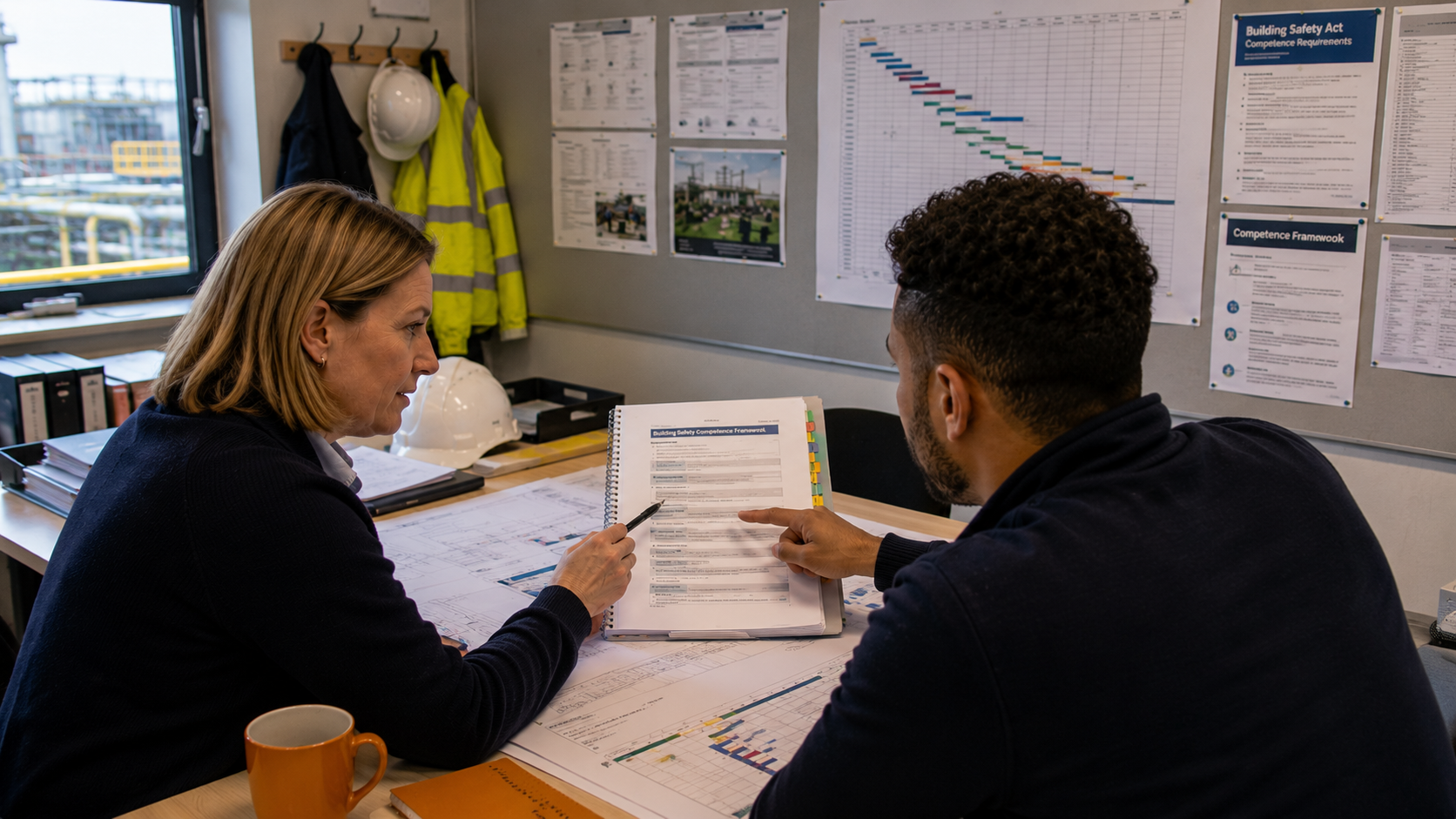
Project managers aren't named duty holders under the Act. But a working group chaired by APM, alongside CIOB and RICS, was tasked with defining what competence looks like for the people supporting those duty holders in practice. The resulting competence framework for project managers in the built environment sets out two thresholds, one for complex projects generally and a higher one for work on Higher Risk Buildings specifically. And it names a route for demonstrating that competence to a regulator: holding chartered status with APM, CIOB or RICS, alongside relevant built environment experience.
That's the thread that connects a job spec back to a specific credential. APM PMQ isn't the finish line here, chartered status is. But PMQ is a recognised assessment on Pathway 3 of APM's route to Chartered Project Professional status, the pathway that launched in September 2024 specifically to give qualification holders a faster, evidence-based route to ChPP rather than a full assessment from a standing start. An employer hiring for a role that touches building safety compliance isn't asking for PMQ because it's a harder exam or a more prestigious badge. They're asking for it because it's a documented, defensible step toward the credential their own compliance obligations increasingly expect someone in that role to be working toward, and it's the step a hiring manager can actually verify at CV stage.
A construction PMO manager described updating her team's hiring criteria after a client audit flagged a gap: several project managers on Higher Risk Building work held strong generalist credentials but nothing that mapped cleanly onto the new competence framework. It wasn't that their PRINCE2 or PMP experience was weak. It was that neither qualification was built around building regulations, duty holder roles or the specific language the framework now uses, and under audit, that mismatch was the thing that got written up. The fix wasn't retraining everyone from scratch. It was making PMQ, and the chartered pathway behind it, an explicit part of how the role was defined and hired for, so the next audit had something concrete to point to.
That's the part general PM certifications don't cover, and it's not a criticism of them. PRINCE2 was built for governance and stage control across any sector. PMP was built for a global, methodology-agnostic standard. APM's framework, by contrast, was written into the same competence conversation as the Building Safety Act itself, with contributions from people who sit on the industry groups actually shaping duty holder obligations. It doesn't just teach project management. It teaches project management inside the specific legal and regulatory shape that UK construction and infrastructure now operate in.
None of this means a PRINCE2-qualified project manager is unemployable in the sector, or that the job spec is being unreasonable. It means the spec is doing something more precise than credential preference. It's a small piece of an organisation's own audit trail, evidence that the person delivering a project on a Higher Risk Building is on a recognised path toward the standard a regulator will eventually expect someone to hold. Naming PMQ in the job spec is the cheapest, clearest way to show that thinking has already happened, before anyone asks the harder question of whether it has.
For anyone weighing up which qualification actually moves the needle on the roles they want next, the specifics of where PMQ sits against PRINCE2, PMP and the chartered pathway are worth working through properly rather than guessing from a job board. If that's useful, get in touch about your APM PMQ training options.
Andre Malowney is a project management trainer accredited across PMI, APMG, APM and PeopleCert frameworks, working with both traditional plan-driven practitioners and Agile delivery teams. Find him on LinkedIn: www.linkedin.com/in/andremalowney.