Facilitation as a Core Project Management Skill
Facilitation has an image problem. It gets filed with the soft skills, somewhere near active listening, and pictured as a person at a flip chart handing out coloured pens. The reality on most projects is more mechanical than that: a decision has to be made, the information needed to make it is distributed across eight people from four organisations, none of whom report to the project manager, and there is one hour in which to get it out of them and into a form somebody will act on. Facilitation is the machinery for that. On a project without command authority, it is close to the only machinery there is.
The Standard for Project Management treats facilitation and support at Section 2.4.3 as a function that has to happen on a project, without insisting that a single named role performs it. That framing is more useful than it first looks. The facilitation on a project is not the workshop; it is every occasion on which a group has to converge, and someone has to make the converging possible.
The job inside the job
A facilitator controls three things, and none of them is the content of the decision.
The sequence. What gets discussed, in what order, and what has to be established before anything else is allowed to start. This is where most of the value sits and most of the preparation goes. A discussion that opens with proposed solutions will spend its hour defending them; the same group asked first to state its constraints, one at a time, with no comment permitted, arrives at the same solutions in twenty minutes and with far less attachment to them.
The participation. Who speaks, for how long, and in what medium. The senior person in the room sets the frame within about ninety seconds of speaking, and everything afterwards is a response to it, which is why the order of speaking is a design decision and not a courtesy. Writing before speaking is the cheapest correction available: two minutes of everyone putting their position on paper produces a genuinely wider set of views than any amount of encouragement to contribute.
The closure. What was decided, who owns the action, and by when. A session that ends in warm agreement and no owner has produced nothing, and everyone present knows it by Thursday. The closing five minutes are worth protecting more fiercely than the opening five, and they are the first thing sacrificed when a discussion overruns.
Why the skill moved to the centre
Two shifts did it. The first is that the expertise needed to make a decision now sits in more heads than it used to. A change to a payment flow touches a product specialist, an engineer, a compliance adviser and an operations lead, and no one of them can answer alone. The project manager's job in that room is not to know more than they do. It is to get what each of them knows into the open in an order that lets a decision form.
The second is that the authority is distributed too, across suppliers, partners and client organisations that share the outcome and share no reporting line. Where nobody in the room can compel anybody else, the quality of the convening becomes the quality of the decision, and a badly convened session does not merely waste an hour. It produces an agreement that three parties interpret differently and discover in eight weeks.
None of this makes directive management obsolete. Where a decision is urgent and belongs to one person, facilitating it is an evasion. Facilitation is for the decisions that genuinely need a group, which on a modern project is a large proportion of them.
Three drawings and a clearance nobody had checked
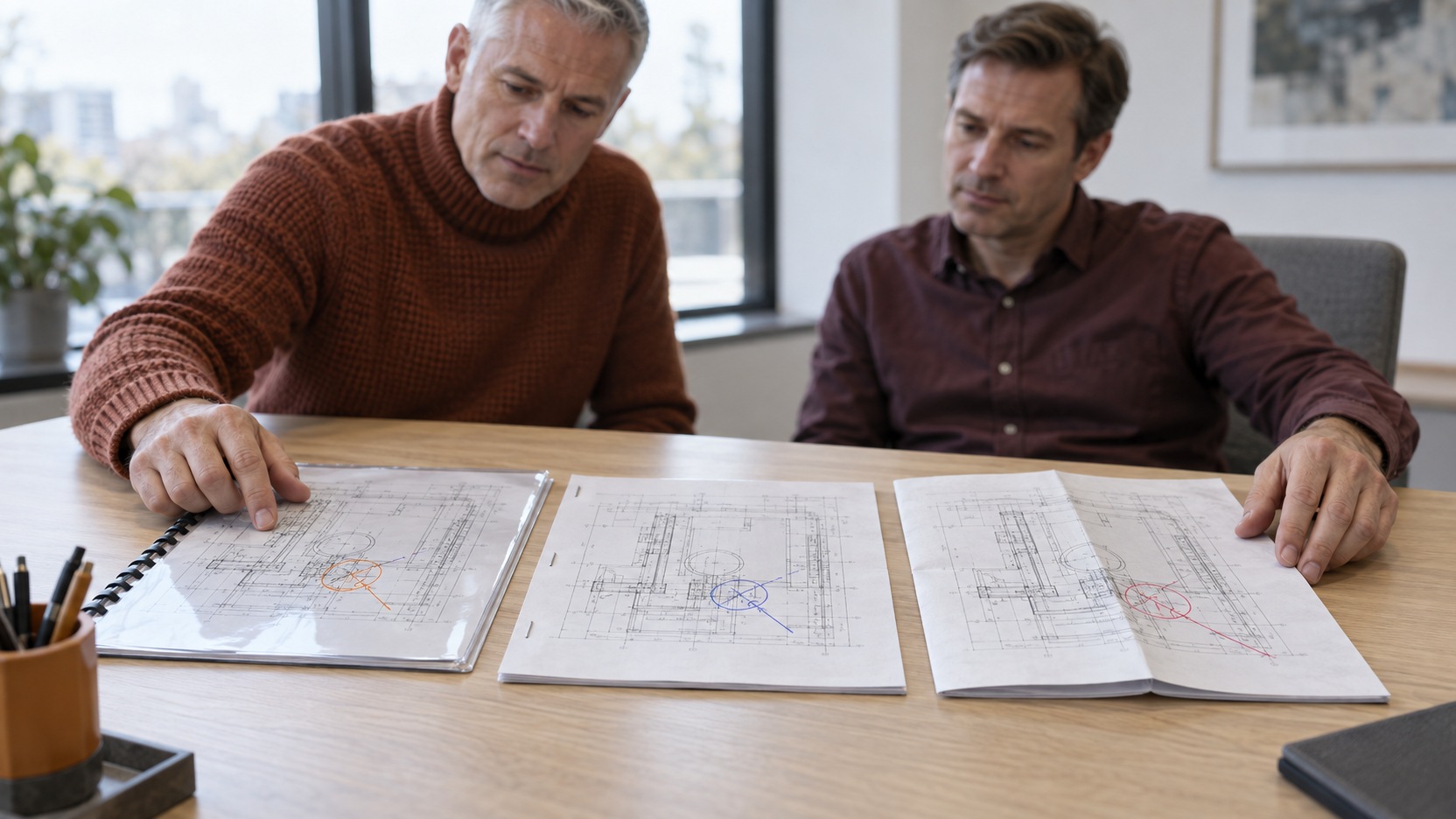
A refurbishment programme in a working laboratory building had stalled on a services interface: where the new air handling met the existing ceiling void above a corridor. Three parties held positions. The client estates team, the main contractor and the equipment supplier had each been asked separately for their view, and each had sent a marked-up copy of the same drawing.
The three markings had never been in the same room. When the project manager laid them side by side on the table at the start of the session, before anyone spoke, the shape of the problem changed in about a minute. Two of the three had marked the void at the same height. The third had marked it forty millimetres lower, because it was working from a survey the others had not seen.
The session was then designed backwards from that. Each party stated its constraint in turn, with no solutions permitted and no interruptions: the supplier's minimum clearance, the contractor's access requirement for maintenance, the estates team's ceiling line in an operational corridor. Those three statements took eleven minutes. Only then was the survey question put, and it was resolved by a phone call to a surveyor during the meeting.
The remaining disagreement was real, and it was about who absorbed the cost of a bulkhead. That went to the sponsor the same afternoon with a single paragraph describing the two options and what each party had said, and it came back in two days. The interface had been open for five weeks. What had kept it open was not difficulty. It was that nobody had convened the three parties in a way that put the constraints before the arguments.
For a PMP® candidate, the reading that helps is that facilitation is a project function with a technique behind it, so a stalled group is worth looking at for the convening that has not happened. A response that gathers people together with no designed sequence has done the visible half of the job. A structured PMP exam preparation course goes over situations where a decision needs several parties and nobody present outranks anybody else.
Three meetings are enough to test this. Look back at the last three meetings you convened and see whether each one produced a decision with a named owner and a date. Where it did not, the cause is usually in the first ten minutes, not the last ten, and it is almost always that people were invited to propose before they were asked to state what they were working with.
Interested in going further?
Convening is a designed activity, and the design is what separates an hour that settles something from an hour that moves it to a corridor. Omega's PMP® Exam Preparation works through decisions that need several parties and no single authority.
Facilitating and supporting appear among the project functions described in The Standard, published with the PMBOK® Guide Eighth Edition.
Ad · Amazon affiliate link.
References
A180: Facilitation Techniques for Difficult Project Conversations
A042: Why Telling the Team What to Do Is Often the Wrong PMP Answer
A007: The Standard for Project Management vs the PMBOK Guide
A025: Where Expertise Ends and Leadership Begins
A043: When Should a Project Manager Escalate?
PMP and PMBOK are registered marks of the Project Management Institute, Inc.