Facilitation Techniques for Difficult Project Conversations
A difficult conversation is one where people want different outcomes, somebody holds more power than the others, and the subject matters. Chairing it well is not a matter of temperament. It is a set of small mechanical moves, most of which are made before anybody sits down, and they work whether or not the facilitator is the calmest person in the building.
Section 5 of the PMBOK® Guide Eighth Edition includes facilitation among the techniques available to a project, and the useful version of it is specific enough to be copied.
Three decisions before the room
Who is in it. Every additional person reduces candour and lengthens the meeting, and some combinations make honesty impossible: a supplier's account manager in a session about that supplier's performance, somebody's line manager in a conversation about their team's capacity. Deciding the attendance list is a facilitation act, and it is the one with the largest effect.
What is being decided. A conversation convened to discuss something will discuss it; a conversation convened to choose between two options will usually choose. Writing the decision as a question, and sending it in advance, does more for the outcome than anything that happens in the hour.
What is not open today. Naming the constraints at the start prevents a class of argument that consumes whole meetings: the date is fixed, the regulatory position is not negotiable, the budget has been set. People accept boundaries stated at the beginning and resent boundaries revealed at minute forty.
Moves that work when it gets hard
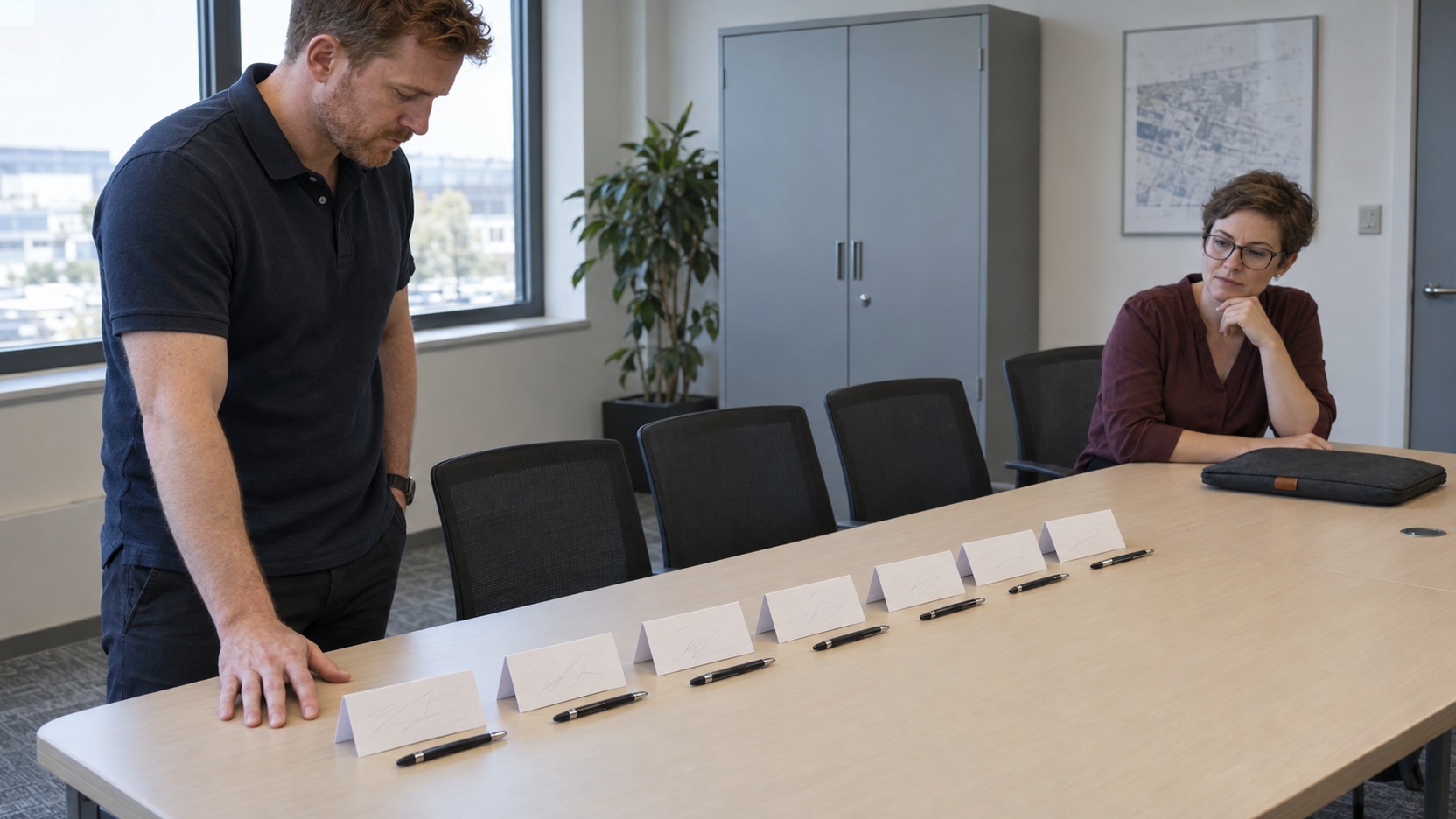
Write before speaking. Two minutes, everybody puts their position on a card, then the cards are read out. This removes the anchoring effect of whoever speaks first, which is usually the most senior person in the room, and it reliably surfaces one or two views that would never have been voiced. It is the single highest-return technique available and it costs two minutes.
Separate generating from judging. Where a discussion keeps collapsing into objections, split it: ten minutes where only options may be offered and no criticism is permitted, then a separate pass where the options are tested. Groups that cannot do this produce exactly the options that survive immediate attack, which is a much smaller set than the good ones.
Ask what would change your mind. Put directly to each party in a stuck disagreement, this question converts a position into a testable claim. Sometimes the answer is evidence that can be obtained by Thursday; sometimes the answer is nothing, which is also useful information and tells you the disagreement is about values or interests rather than facts.
Take it out of the room. Where two people are locked and eight others are watching, a short break with the two of them and the facilitator is more likely to move it than another twenty minutes in front of an audience. Positions harden in public, and both parties know it.
A design review that had been lost before it started
A defence programme held a design review on a contested interface between the mission system and the platform. Fourteen people, three organisations, and a history: the same question had been reviewed twice before and had both times been settled by the most senior engineer present stating a preference in the first ten minutes.
The third review was run differently, and every change made to it was mechanical. The invitation stated the decision as a question with two named options. The attendance was cut from fourteen to seven, because four of them had no stake and three were there to observe. The session opened with the constraints: the qualification route and the delivery date were fixed, the mounting arrangement was not.
Then everybody wrote. Seven folded cards on the table, face down, two minutes, and the facilitator read them out in a random order without names attached. Four of the seven favoured the option that had been dismissed in both previous reviews, including one from the organisation that had opposed it. Two of those four had not spoken in either earlier meeting.
The conversation that followed was still difficult and it was about the interface rather than about who was in charge of it. The what-would-change-your-mind question produced a specific test that the systems engineering lead could run in eight days, and the meeting closed by agreeing to reconvene for twenty minutes once that result existed.
The test came back ambiguous, which nobody had expected, and the twenty-minute session chose the third option that had emerged from the cards. The whole sequence took a fortnight against two earlier reviews that had each settled the matter in an hour and neither of which had held.
Closing a difficult conversation
State what was decided and what was not. Out loud, at the end, in the room. Half of the disputes that follow a contested meeting are about what people believed had been agreed, and a facilitator who spends the last four minutes on this prevents most of them.
Say what happens to the disagreement that remains. Where people have not been persuaded, name that, record it, and say where it goes: to a sponsor, to a test, to a review in a month. Unresolved disagreement that is acknowledged stays manageable. Unresolved disagreement that has been smoothed over in the closing summary reappears with interest.
For a PMP® candidate, the useful reading is that facilitation is a set of designed moves, so a scenario where a decision keeps being reopened is worth reading as a process that never settled it. A response that escalates for a ruling may produce a decision nobody in the room supports. A structured PMP exam preparation course practises situations where the disagreement is real and the room can still be made productive.
Try the writing move at your next contested meeting. Two minutes, everybody puts their position on a card, read them out without names. It feels awkward for about fifteen seconds and it changes what the next hour contains.
Interested in going further?
The hardest conversations on a project are usually settled by whoever speaks first, which is a design fault in the meeting rather than a fact about the people. Omega's PMP® Exam Preparation works through facilitation as a set of deliberate techniques.
Facilitation techniques are described among the tools in the PMBOK® Guide Eighth Edition.
Ad · Amazon affiliate link.
References
A182: Multicriteria Decision Analysis Explained
A162: Decision Trees Without the Headache
A161: Expected Monetary Value Explained
A187: Retrospectives That Lead to Change
A178: SWOT Analysis in Project Management
PMP and PMBOK are registered marks of the Project Management Institute, Inc.