What Is Management of Portfolios (MoP)?
Most project managers who train through PRINCE2, then MSP, then M_o_R, eventually hit a fourth name on the list and stall. MoP gets mentioned in passing, filed under "something for the executives," and left alone. Delegates assume it sits above their level, or they assume it duplicates MSP, or they simply run out of certifications to chase before they ever look at what it does.
That hesitation has become slightly more understandable lately, because the qualification changed its name. If you search for MoP now, you will find some pages still calling it Management of Portfolios and others calling it PRINCE2 Portfolio Management, with no obvious explanation of whether these are the same thing or a replacement for it. Training providers list both terms side by side. AXELOS material and PeopleCert material do not always match. For anyone trying to work out whether this qualification is worth their time, the naming confusion sits directly in front of the actual answer.
They are the same framework. PeopleCert has folded MoP into the PRINCE2 family alongside PRINCE2 itself, MSP, and M_o_R, and rebranded it PRINCE2 Portfolio Management to make that family relationship explicit on the certificate and on the syllabus. The content, the two exam levels, and the underlying method have not been rewritten from scratch. What changed is the label, and the positioning: this is now presented as part of one coherent PRINCE2 suite rather than a standalone AXELOS product that happened to share a governing body.
What the framework actually does is worth being precise about, because it answers a different question to every other certification on that list. PRINCE2 governs how you run a single project. MSP governs how you coordinate a group of related projects toward a shared outcome. MoP sits a level above both of those. It governs which projects and programmes an organisation should be running in the first place, and which ones it should stop funding, given finite money, finite people, and a strategy that only some of the current workload actually supports. The framework's own definition describes portfolio management as a coordinated set of strategic processes and decisions that balance organisational change against business as usual. In plainer terms: it is the discipline of deciding what earns a place on the list before anyone touches a project plan.
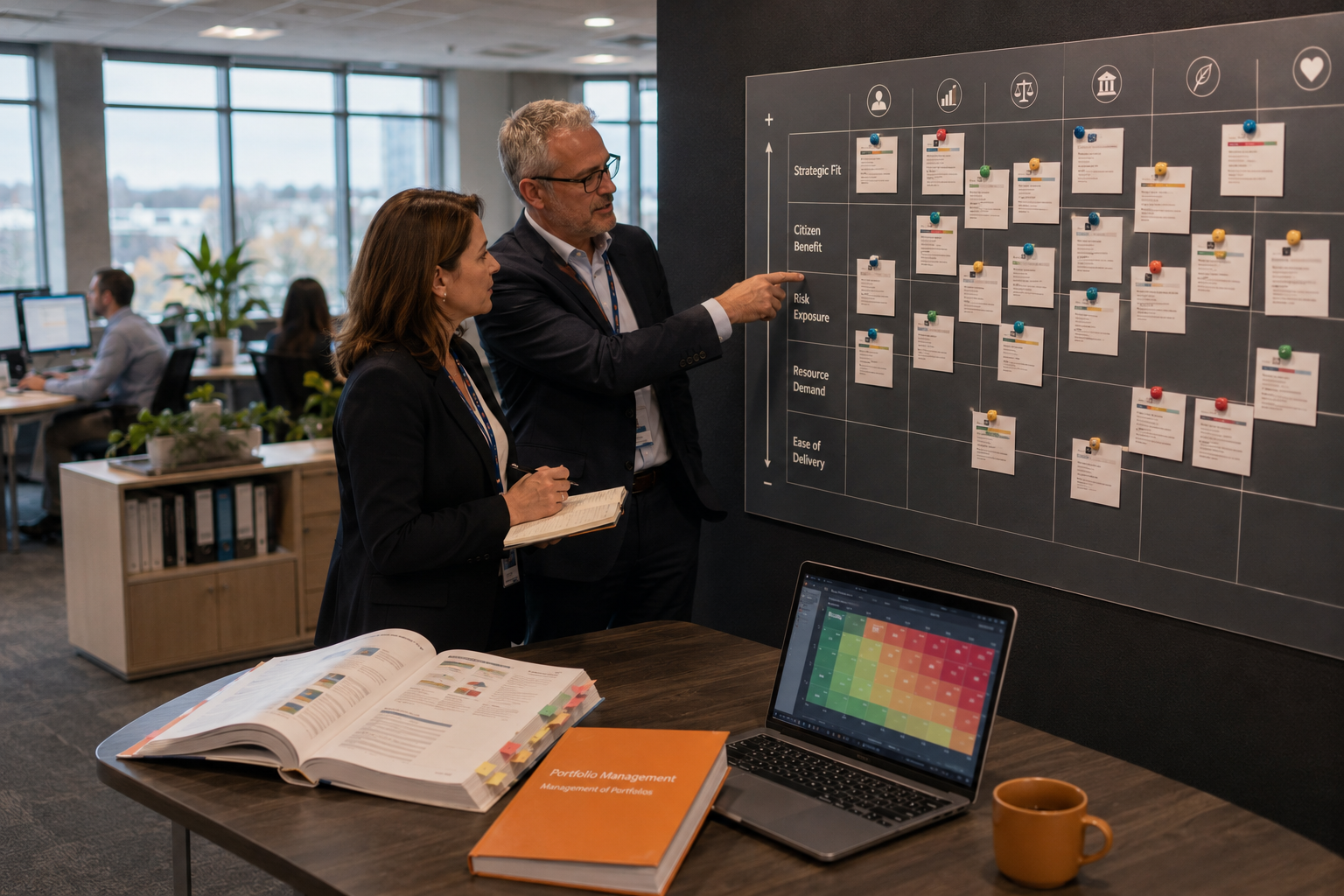
That distinction matters more than it first appears. A delivery team can run flawless PRINCE2-governed projects for years and still watch the organisation underperform, because the wrong projects were selected at portfolio level and no PRINCE2 process was ever going to fix that from inside the plan. A consultant working with a public-sector programme office described exactly this pattern: three well-run, well-governed projects competing for the same specialist resource, each one individually justified, none of them ranked against the others until a portfolio director finally sat down with a prioritisation matrix and asked which two actually moved the organisation's strategy forward. The projects were not the problem. The absence of a portfolio-level decision was.
MoP is built for the people who make that kind of call, or who support the people making it. That includes management board members and directors of change, but it also includes portfolio managers, PMO leads, and programme or project managers who sit close enough to investment decisions that understanding the logic behind them changes how they pitch, prioritise, and report. You do not need to already hold a board seat for this to be relevant. You need to be someone whose work depends on decisions made above the level of any single plan.
Structurally, MoP mirrors the rest of the PRINCE2 family: a Foundation exam followed by a Practitioner exam, with Foundation as a prerequisite for sitting Practitioner. Foundation is fifty multiple-choice questions in forty minutes, closed book, with a fifty per cent pass mark, so twenty-five correct answers clears it. That level tests recall of the principles, cycles, and practices that make up the framework, in the same way PRINCE2 Foundation tests recall before Practitioner tests application. Practitioner is a different shape of exam. It runs to three hours across four scenario-based questions worth twenty marks each, eighty marks total, and it is open book, using only the official printed manual with permitted annotation. Candidates need forty marks to pass. The open-book format is deliberate: Practitioner is checking whether you can apply the guidance to a live, messy scenario under time pressure, not whether you have memorised it, which is a genuinely different skill from Foundation and worth preparing for differently.
Both certificates need renewing within three years to stay current, in line with how the wider PRINCE2 suite now handles ongoing recognition, so this sits alongside the same recertification rhythm as PRINCE2 and MSP rather than a separate system to track.
None of this makes MoP a qualification you add because it looks good on a CV next to the others. It earns its place when your role, or the role you are aiming at, involves justifying why a project deserves funding relative to everything else competing for the same money and people. For a project manager who has only ever operated inside an already-approved plan, that is a genuinely different kind of thinking, and it is the one gap that PRINCE2, MSP and M_o_R were never designed to close. If you are weighing this one up against the rest of the family, and want to talk through where it actually fits your own trajectory rather than the generic pitch, get in touch about your project management training options and we can work through it properly.
Andre Malowney is a project management trainer accredited across PMI, APMG, APM and PeopleCert frameworks, working with both traditional plan-driven practitioners and Agile delivery teams. Find him on LinkedIn: www.linkedin.com/in/andremalowney.