What Is Better Business Cases, and What Is the Five Case Model?
Most business cases fail for a reason nobody wrote down. The numbers are usually fine. The spreadsheet balances, the return on investment looks respectable, the slide deck is polished enough to survive a steering group. And still the proposal stalls, gets sent back with three pages of questions, or dies quietly in someone's inbox because nobody can quite say why they're uneasy about it.
The usual explanation is that the case wasn't persuasive enough. Better story, better slides, more confident presenter. That explanation is almost always wrong. A business case doesn't fail because it wasn't convincing. It fails because it answered the wrong question, or answered one question five times over while leaving four others untouched.
This is the gap the Five Case Model was built to close.
It comes out of HM Treasury's Green Book, the guidance that UK government departments use to appraise spending proposals before public money moves. Better Business Cases is the APMG-accredited training and certification built around that model, and it has been running for over a decade, with tens of thousands of people now certified through it. The model itself has spread well beyond its original public-sector home, but its logic still shows most clearly in the environment it was designed for: a room where somebody has to defend a spending decision to people who weren't in the room when the idea was born, and who have every right to ask why it deserves the money.
The structure is deceptively simple. A business case has to answer five separate questions, not one blended pitch.
The strategic case asks whether there's a genuine case for change at all. Not whether the solution is good, but whether the problem is real, whether it connects to something the organisation is actually trying to achieve, and whether doing nothing is a defensible option or a slow failure in progress. Skip this and you get proposals that solve a problem nobody agreed exists.
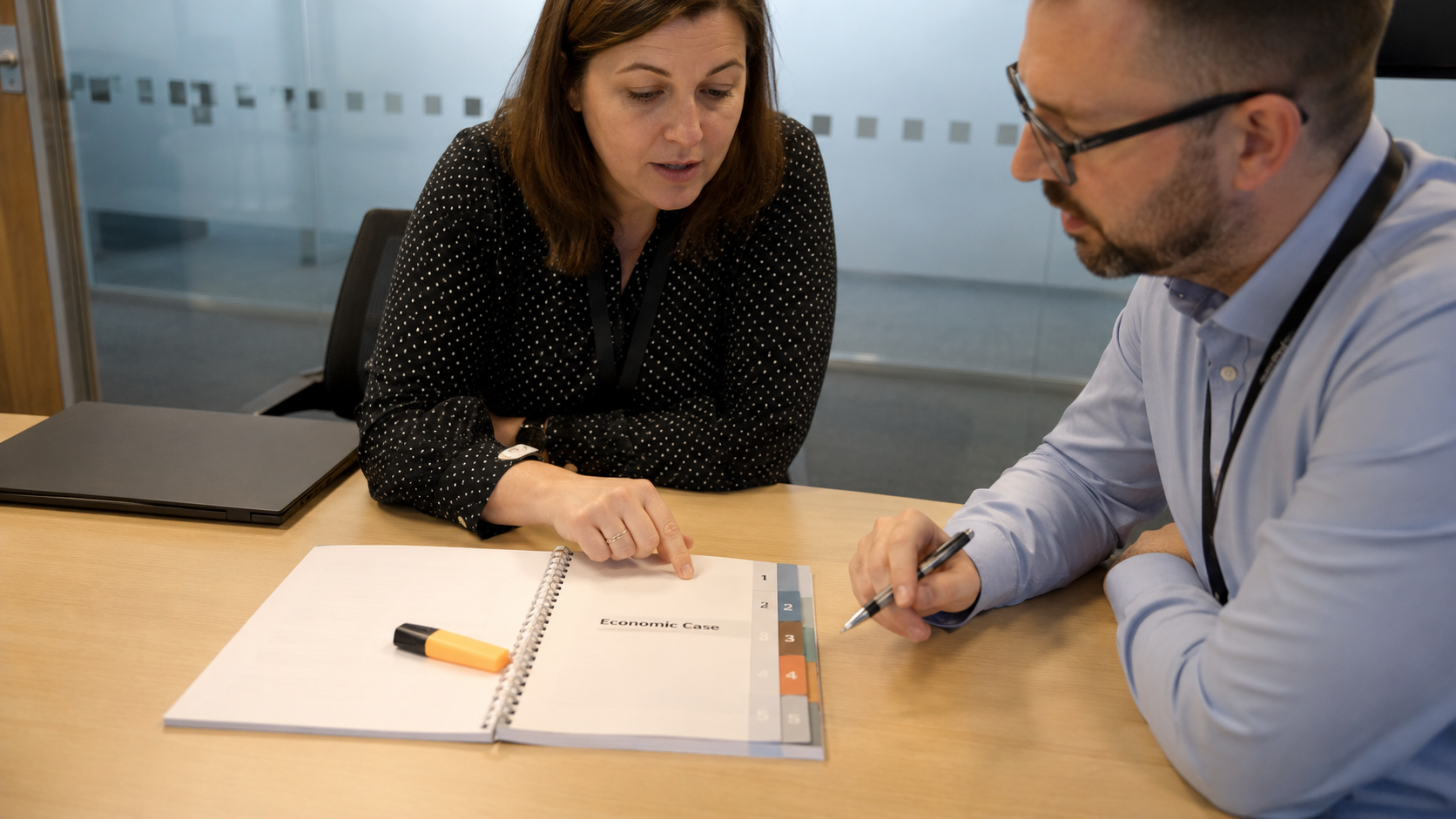
The economic case asks whether the preferred option represents the best value, not the cheapest option or the most exciting one, but the one that gives the most benefit for the resource committed, weighed honestly against realistic alternatives, including the option of doing nothing or doing the minimum.
The commercial case asks whether the deal itself stands up. Can it actually be procured, contracted and delivered in practice, with terms that protect both sides and a market that will realistically supply it. A proposal can be strategically sound and economically attractive and still be commercially unworkable, and that gap is where a lot of public and private projects quietly come apart later.
The financial case asks the blunter question: can we actually afford it. Not just this year, but across the funding period, with contingency built in rather than assumed. This is where a strategically brilliant idea sometimes has to wait, not because it's wrong, but because the money genuinely isn't there yet.
The management case asks whether the organisation can deliver it. Governance, resourcing, risk management, a realistic plan, someone accountable for making it happen. A proposal can pass every other test and still fail here, because good intentions and a signed-off budget don't deliver anything on their own.
Here's where it gets useful in practice. A public sector programme office once had a proposal rejected twice before anyone worked out why. The economic case was strong. The financial numbers were solid. What the team hadn't done was separate the strategic case from the economic case, so reviewers kept reading a document that argued benefits and value together, without ever cleanly establishing that the underlying problem justified action in the first place. Once they split the two apart and answered each on its own terms, the same proposal, with barely different numbers, went through in a single pass. Nothing about the substance changed. The structure did.
That's the real function of the Five Case Model. It isn't a template for writing a longer document. It's a discipline that stops five separate arguments from getting tangled into one, so a reviewer can test each one on its own terms instead of accepting a blended impression that sounds persuasive but doesn't actually hold up when someone pulls a single thread.
It also explains why some very experienced project managers, people who have run delivery successfully for years, still find the model unfamiliar the first time they meet it properly. PRINCE2 assumes a business case exists and focuses on keeping it viable through delivery. Managing Successful Programmes assumes something similar at programme level. Neither one teaches you how to build the case itself, case by case, question by question, in a way that survives real scrutiny. That's a different skill, and it sits underneath governance rather than inside it.
None of this makes a business case interesting to write. It was never meant to. It makes a business case defensible, which turns out to matter a great deal more the first time someone senior asks a question you hadn't prepared for. If you want to talk through where this fits against the frameworks you already hold, get in touch about business case training options and we can work out whether Foundation or Practitioner is the right starting point.
Andre Malowney is a project management trainer accredited across PMI, APMG, APM and PeopleCert frameworks, working with both traditional plan-driven practitioners and Agile delivery teams. Find him on LinkedIn: www.linkedin.com/in/andremalowney.