Do You Need MSP If You Already Have PRINCE2?
A PRINCE2 Practitioner will tell you, correctly, that the framework is thorough. Stages, tolerances, a business case that gets checked at every boundary, a project board that can stop the whole thing if it stops making sense. Run it properly and a single project rarely goes off the rails without someone noticing early enough to act.
Then a delegate comes back from three years running exactly that kind of project, competently, and describes a different problem entirely. Not a project that failed. A set of projects, all individually well governed, all reporting green, that somehow don't add up to what the organisation actually needed. One delivered on time and under budget and nobody used it. Another got starved of resource in month four because a louder project claimed the same specialist, and there was no forum where that trade-off was made deliberately rather than by whoever shouted first. A third kept going for two years after the strategic reason for it had quietly changed.
PRINCE2 has nothing to say about any of that. It was never built to. The framework is explicit about its own boundary: it governs a project, and a project is defined by having a fixed, agreed set of objectives. Everything PRINCE2 does well, the tolerances, the stage boundaries, the tight change control, depends on that objective staying still long enough to manage against it.
The situations above don't involve one objective staying still. They involve several projects moving at once, competing for the same people and the same budget, in service of a strategic outcome that itself shifts as the organisation learns. That is a programme, in the specific technical sense the word carries in this world, not just a big project or a loose collection of related work. And managing it is a different discipline with a different set of tools, which is what Managing Successful Programmes, MSP, actually is.
It helps to be precise about where the line sits, because "programme" gets used loosely in most organisations, including by people who should know better. A programme, properly defined, exists to deliver a strategic outcome that no single project could deliver alone, and that requires active trade-offs between the projects underneath it as circumstances change. If your organisation is transforming how it delivers a service, migrating a system while retraining the people who use it, or restructuring while three separate workstreams have to land in a coordinated order, that's a programme. If you're delivering one system for one team by one date, however large, that's still a project, and a well-run PRINCE2 project at that.
MSP, now in its fifth edition and maintained by PeopleCert since it took over the AXELOS best practice portfolio in 2021, is built around seven principles, seven themes and a set of processes that walk a programme through its lifecycle. Where PRINCE2 asks whether a project remains justified against a business case fixed at the start, MSP asks a harder question repeatedly through the life of a programme: does this collection of projects still add up to the outcome we said we wanted, and if a trade-off has to be made between two of them, who is actually authorised to make it. That authority, and the mechanism for exercising it, is the part PRINCE2 genuinely doesn't cover, because it was never asked to.
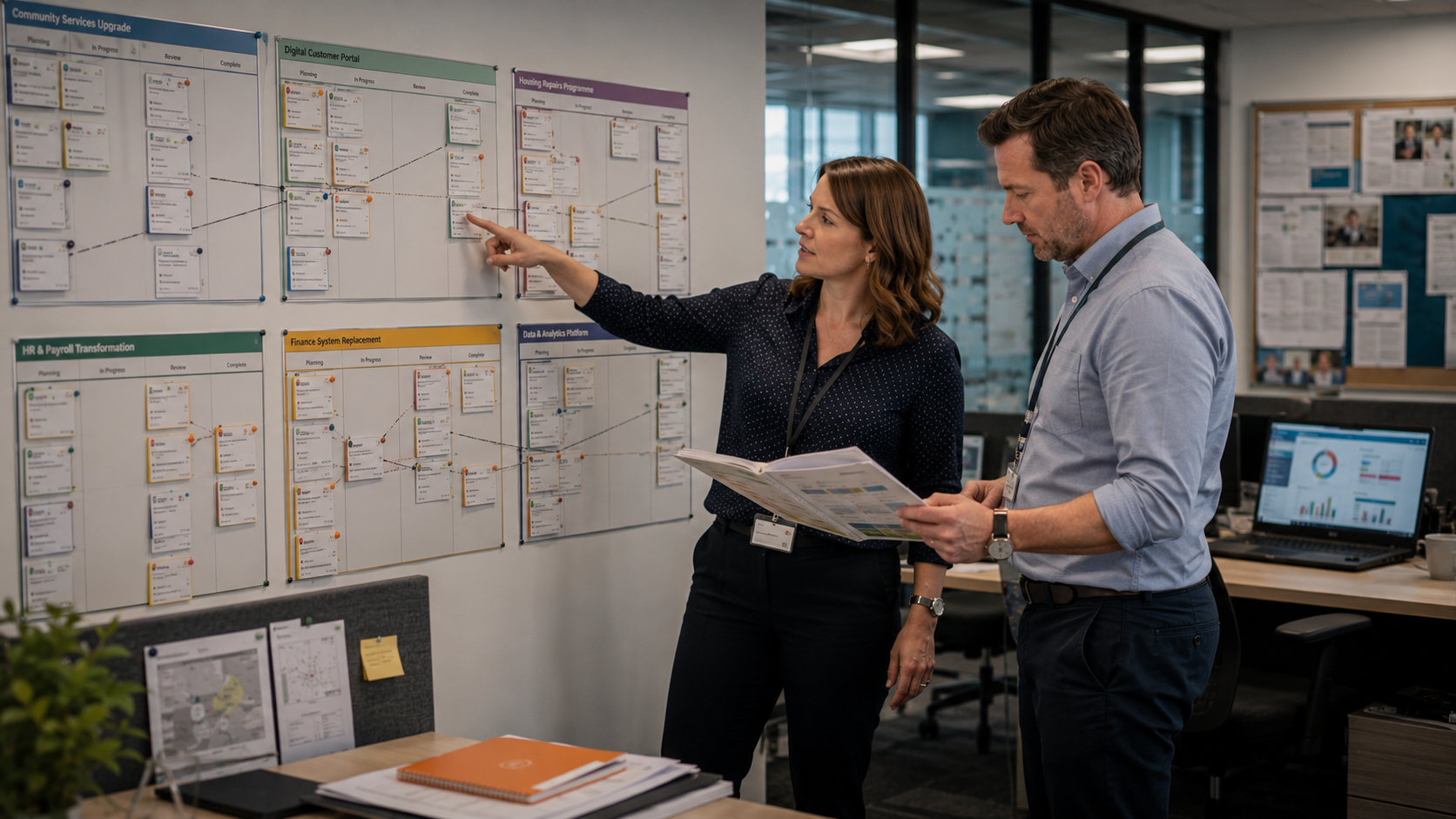
Picture a programme office inside a public-sector organisation running a multi-year service redesign. Three project boards sit on the same wall, each one PRINCE2-disciplined, each one reporting amber or green in isolation. The programme manager's actual job that week is standing in front of all three at once, tracing a dependency between two of them that neither project board can see from inside its own tolerances, because neither has visibility of the other's slippage or the shared resource both are quietly drawing on. That view across the whole, and the authority to reprioritise based on it, is what a programme role adds. It isn't a bigger version of what a project manager already does. It's a genuinely different vantage point, and MSP is the framework built to work from it.
None of this makes PRINCE2 obsolete once you reach that point, and it's worth being direct about that, because some training providers imply otherwise to sell the next course. A programme under MSP still contains projects, and those projects still benefit from being run under PRINCE2 discipline underneath the programme layer. The two frameworks sit in the same PeopleCert product suite for exactly that reason, alongside Management of Portfolios and Management of Risk, and they're designed to interlock rather than compete. MSP doesn't replace the project-level rigour. It sits above it, coordinating several PRINCE2-run projects toward a strategic outcome that none of them could deliver alone, and it gives someone the explicit authority to make the trade-offs between them that a single project board was never positioned to make.
So the honest test isn't whether your projects feel demanding, or whether you're managing several of them at once through sheer competence and long hours. It's whether the outcome you're accountable for depends on trade-offs between projects that no single project board has the authority or the visibility to make. If it does, that's the specific gap MSP exists to close, and the shift from PRINCE2 alone to PRINCE2 underneath MSP is less about learning a new set of documents than about being formally handed the authority to make decisions you may already be making informally, without the framework or the mandate to back them. If that gap sounds familiar, it's worth talking it through properly rather than guessing at where your organisation's need actually sits, and we're always happy to get in touch about your PRINCE2 and MSP training options to help you work out which one, or which order, fits what you're actually facing.
Andre Malowney is a project management trainer accredited across PMI, APMG, APM and PeopleCert frameworks, working with both traditional plan-driven practitioners and Agile delivery teams. Find him on LinkedIn: www.linkedin.com/in/andremalowney.